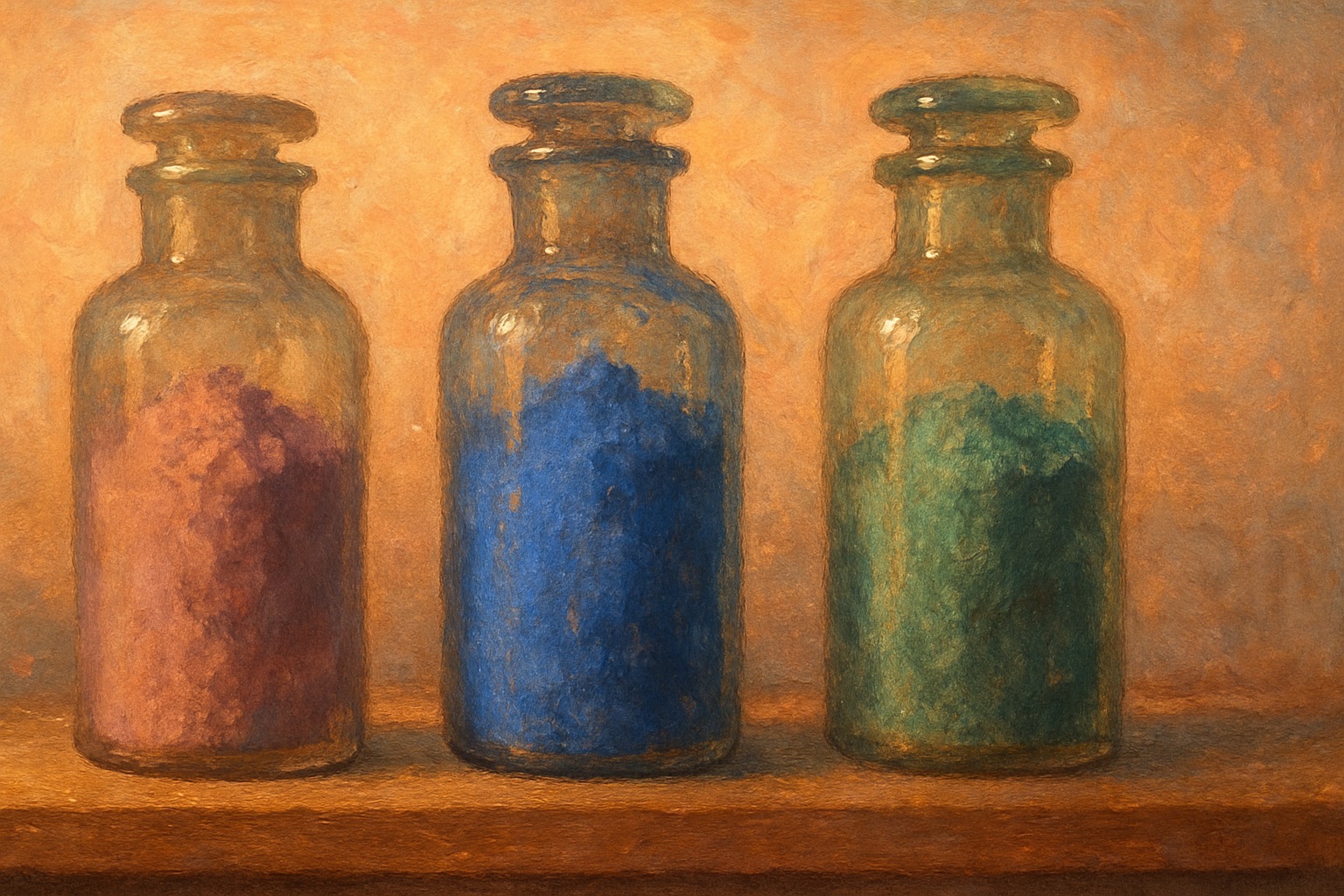
Every color in your life has a rap sheet. Some made teenagers rich, some quietly poisoned entire drawing rooms, and at least one started a feud between grown adult artists.
Mauve was invented by accident in 1856 by an 18-year-old trying to cure malaria.
William Perkin was attempting to synthesize quinine from coal tar and got a vivid purple sludge instead — the first synthetic dye. Queen Victoria wore the color, Punch magazine diagnosed London with 'mauve measles,' and Perkin got rich enough to retire to pure research at 36.
For centuries, ultramarine blue cost more than gold.
It was ground from lapis lazuli hauled out of a handful of mines in Afghanistan, so Renaissance patrons wrote it into contracts and reserved it for the Virgin Mary's robes. A cheap synthetic version in the 1820s finally broke the world's prettiest cartel.
Scheele's green — the most fashionable color of the Victorian era — was made of arsenic, and it shed.
The copper-arsenite pigment tinted wallpaper, dresses, and even confectionery, sickening people by the roomful. The famous theory that Napoleon's green wallpaper on St. Helena helped kill him is real science but still debated: his wallpaper did contain arsenic, while his autopsy pointed to stomach cancer.
Tyrian purple was squeezed out of sea snails — by one estimate, around 10,000 of them per gram of dye.
That arithmetic is why purple meant royalty: Rome and Byzantium rationed the color by rank, and legitimate imperial heirs were literally titled 'born in the purple.'
Vantablack — a coating so dark it visually erases 3D shapes — is licensed for art to exactly one person.
Sculptor Anish Kapoor secured exclusive artistic rights in 2016, so artist Stuart Semple retaliated with pigments sold to 'everyone except Anish Kapoor.' Kapoor's rebuttal was an Instagram photo of his middle finger dipped in Semple's pink.
Mummy brown was exactly what it sounds like: paint made from ground-up Egyptian mummies.
Painters used it for centuries; when Pre-Raphaelite Edward Burne-Jones learned what was in his tube, he reportedly gave it a solemn burial in his garden. The pigment only died out when the supply of mummies did.
Indian yellow was said to come from the urine of cows fed nothing but mango leaves.
The tale hangs largely on a single 1883 investigation, and historians spent a century calling it legend — but the pigment's main component is a metabolic byproduct consistent with an animal origin, so the cows may deserve their credit after all.
Carmine red comes from crushed insects — roughly 70,000 of them per pound of dye — and it's probably in your kitchen.
Cochineal made red one of colonial Spain's most valuable exports from Mexico, second only to silver, and it still colors food and lipstick today under the polite alias E120.
Yves Klein registered his own blue with the French patent office.
International Klein Blue isn't a new pigment — it's ultramarine suspended in a special matte binder that preserves the raw powder's electric glow. Klein filed the formula in 1960 via a Soleau envelope, one bureaucratic step short of a full patent.
The whitest white for 2,000 years was lead — worn on faces as well as canvases.
Painters got 'painter's colic'; aristocrats fared worse. Maria Gunning, Countess of Coventry and a celebrated beauty, died in 1760 at 27, her death widely blamed on lead-based cosmetics.
Han purple, a pigment used on the Terracotta Army, does quantum tricks physicists are still chewing on.
Chill the barium copper silicate near absolute zero in a strong magnetic field and its magnetic waves stop propagating in three dimensions and behave in two — a result Stanford and Los Alamos researchers published in 2006. The Han dynasty chemists just liked the color.
'Drunk-tank pink' was deployed in real jail cells because a 1970s study said it made people weaker and calmer.
Cells got painted bubblegum after Alexander Schauss's experiments at a Navy correctional facility — the shade, Baker-Miller pink, is named for its two commanding officers. Later replications have been decidedly mixed, so file the calming effect under 'debated.'
Twelve colors, and the pettiest entry by a mile is the pink sold to every human on Earth except one specific sculptor.