Engineering has rules. The projects below read them, nodded politely, and then did the impossible anyway — usually with physics doing the heavy lifting for free.
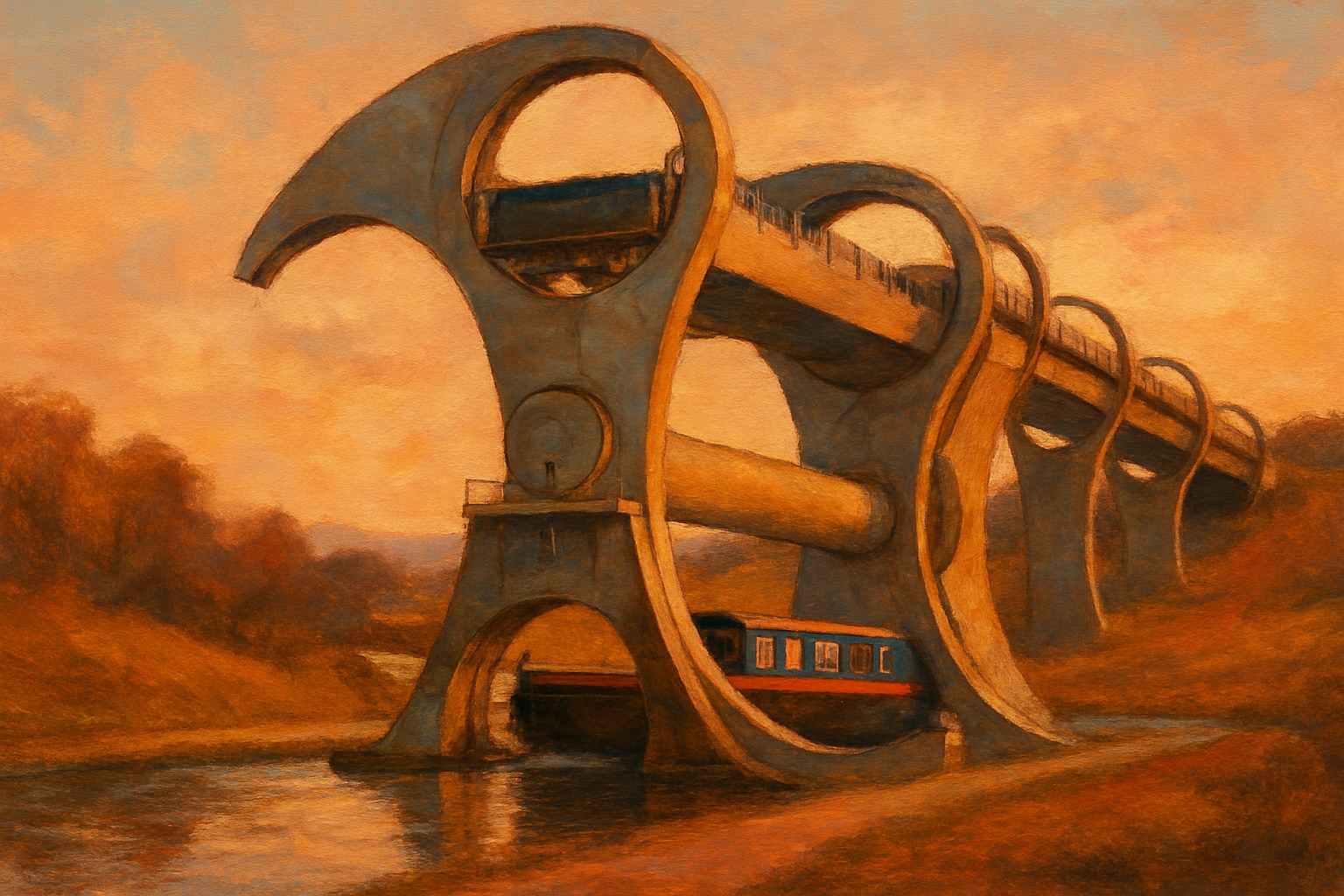
The Falkirk Wheel — the world's only rotating boat lift — hoists boats 24 meters using about as much power as boiling eight kettles.
Archimedes gets the credit: a boat displaces exactly its own weight in water, so the two gondolas always balance no matter what's floating in them. One rotation of the Scottish giant uses roughly 1.5 kWh.
The Netherlands' Maeslantkering storm barrier has two swinging arms, each about as long as the Eiffel Tower is tall — and no human decides when it closes.
A computer watches the storm-surge forecasts and shuts Rotterdam's front door on its own. The larger Delta Works it belongs to was named one of the Seven Wonders of the Modern World by the American Society of Civil Engineers.
The Eastgate Centre in Harare, Zimbabwe stays comfortable with almost no air conditioning — because its architect copied termite mounds.
Mick Pearce's 1996 design breathes like a mound, storing coolness in its mass and venting heat through chimneys; by its designers' estimates it uses around a tenth of the climate-control energy of a comparable conventional building.
Roman harbor concrete gets stronger when seawater attacks it — the exact process that destroys modern concrete.
A 2017 study led by geologist Marie Jackson, published in American Mineralogist, found that seawater reacting with the volcanic ash in the mix grows rare aluminous tobermorite crystals inside the cracks — a self-healing act that's been running for 2,000 years.
The Millau Viaduct in France is taller than the Eiffel Tower.
Its tallest mast rises 343 meters — the Eiffel tops out at 330 — and the road deck floats some 270 meters above the Tarn valley, occasionally above the clouds.
The Pantheon's dome is still the world's largest made of unreinforced concrete — finished around 126 AD, with a hole in the top.
Roman engineers thinned the shell and lightened the aggregate toward the crown, and the open oculus rains straight onto a subtly sloped floor with hidden drains. Nineteen centuries, zero rebar.
Germany's Magdeburg Water Bridge carries ships over a river — and a fully loaded barge adds zero weight to the bridge.
Archimedes again: a floating ship displaces its own weight in water, so the 918-meter trough weighs the same whether it's empty or hosting a freighter.
Taipei 101 hangs a 660-ton steel sphere near its top — on purpose, where tourists can see it.
The tuned mass damper swings against typhoon and earthquake sway, steadying the tower like a pendulum counterweight. Most skyscrapers hide theirs; Taipei gave its own a viewing deck.
The Trans-Alaska Pipeline stands on roughly 124,000 radiators — heat pipes that refrigerate the ground.
Warm oil would thaw the permafrost and sink the line, so thermosyphons pull heat out of the soil while the zigzag layout lets 800 miles of steel flex. It rode out a magnitude-7.9 earthquake in 2002 without spilling a drop.
Manhattan's Citicorp Center stands on nine-story stilts placed at the middles of its sides — not the corners — to float above a church that refused to move.
In 1978 a student's question exposed a fatal weakness to diagonal winds, so crews secretly welded reinforcements at night, race-against-hurricane-season style. The public didn't learn the full story until 1995.
The Bell Rock Lighthouse was built on a reef that spends most of every day underwater — completed in 1810, masonry untouched since.
Robert Stevenson's crews could work only a couple of hours per low tide, dovetailing granite blocks together like a stone puzzle. Two centuries of North Sea storms haven't budged it.
Hoover Dam's concrete would still be curing today if engineers hadn't run 582 miles of refrigeration pipe through it.
Poured as one mass, the chemical heat of curing would have taken more than a century to escape and cracked the dam apart; ice-cold water pumped through embedded pipes finished the job in under two years.
Kansai International Airport sits on an artificial island engineers always knew would sink — so they put the terminal on jacks.
The island has settled more than 12 meters into Osaka Bay's soft clay, and workers periodically level hundreds of columns with hydraulic jacks and shims to keep the floors flat.
The last Inca rope bridge is woven from grass — and it's been continuously renewed for roughly 500 years.
Every June, four Quechua communities weave the Q'eswachaka anew from twisted q'oya grass across the Apurímac gorge, a tradition UNESCO recognized in 2013. The bridge is always younger than a year and older than most countries.
Respect to every one of them, but the trophy goes to the Citicorp welders — quietly saving a skyscraper by night and telling no one for seventeen years.