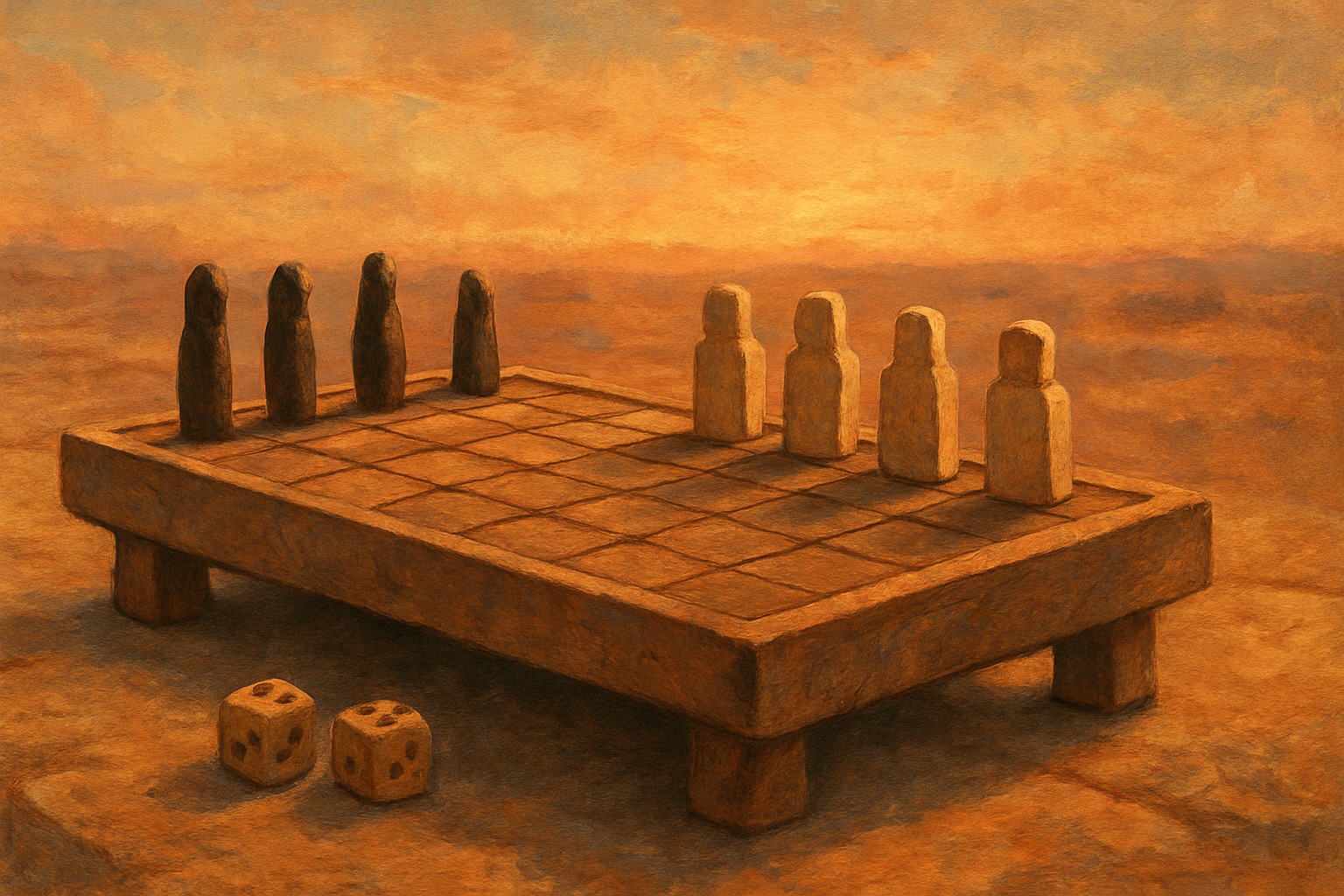
Whatever you played on game night, someone in the Bronze Age would probably have recognized it. Humanity invented fun early — and then mostly stopped improving on it.
Egyptians were playing senet before the pyramids existed — and Tutankhamun was buried with multiple boards.
Boards and depictions go back around 5,000 years, and by the New Kingdom the game had turned theological: winning symbolized safe passage into the afterlife. Board games as funeral equipment.
Go has been played essentially unchanged for at least 2,500 years — with tradition claiming 4,000-plus.
Chinese legend says Emperor Yao invented it to sharpen an unruly son, but historians can only firmly attest the game by around the 4th century BC — the 4,000-year figure is tradition, not evidence. Either way, it's arguably the oldest game still played in close to its original form.
The Royal Game of Ur died out for some 2,000 years — until a British Museum curator deciphered its rules off a clay tablet.
Boards from the royal tombs of Ur date to around 2600 BC, and a Babylonian scribe recorded rules in 177 BC. Curator Irving Finkel decoded them, then played the resurrected game against YouTuber Tom Scott in a video watched millions of times.
Playing cards were invented in China — Europe didn't see them until roughly the 1370s.
References to a 'leaf game' appear in Tang-dynasty China by the 9th century; cards then traveled west through the Islamic world, where Mamluk suits of cups, coins, swords, and polo sticks mutated into the decks Europe still argues over.
Romans cheated at dice — archaeologists keep finding loaded ones.
Excavated Roman dice turn up weighted or subtly shaved to favor certain rolls, though scholars caution that some lopsided dice may just be sloppy manufacturing. Pompeii's tavern walls, helpfully, include a painting of dice players being thrown out mid-brawl.
Marbles were grave goods in Egypt around 5,000 years ago.
Small polished stone balls were found in a child's grave at Naqada from the predynastic era, and similar spheres appear at Indus Valley sites. Children everywhere reached the same conclusion independently: round rocks are excellent.
Chess began as chaturanga in India around the 6th century AD — and the queen was a late, terrifying upgrade.
'Checkmate' descends from the Persian shah mat — popularly rendered 'the king is dead,' though linguists prefer 'the king is helpless.' The queen only gained her sweeping modern powers in 15th-century Europe, in a variant contemporaries actually called 'mad queen chess.'
A game set from Iran's Burnt City is on the order of 4,500 to 5,000 years old — dice included.
The Shahr-e Sukhteh find is often billed as an ancestor of backgammon and contains some of the oldest known dice, though scholars debate both the dating and exactly what was played. Whatever it was, the dice-and-race formula clearly had legs.
Mancala boards are carved into bedrock across Africa and the Middle East — and nobody can say how old the oldest ones are.
Rows of pits chipped into stone can't be radiocarbon dated, so age claims range from centuries to millennia; the honest answer is 'ancient, extent unknown.' The game itself remains one of the most widely played on Earth.
The yo-yo appears on a Greek vase from around 440 BC.
A painted boy works a disc on a string, and terracotta yo-yos survive in museums. The story that it began as a Filipino jungle hunting weapon is myth — though the word 'yo-yo' and the modern craze genuinely did arrive from the Philippines via 1920s America.
The ancestor of jacks was played with actual ankle bones — for fun and for prophecy.
Greek and Roman children tossed astragaloi, the ankle bones of sheep and goats, while adults cast the very same bones to read the will of the gods. Same equipment, different stakes.
Snakes and Ladders started as an Indian morality lesson.
In gyan chaupar, ladders were virtues, snakes were vices, and the goal was spiritual liberation. Victorian Britain imported the board and swapped the theology; Milton Bradley sanded it down to Chutes and Ladders in 1943.
Egyptians 4,000 years ago played a pegs-and-holes race game that looks suspiciously like a cribbage board.
'Hounds and Jackals' sets from the Middle Kingdom — including an elegant one excavated at Thebes, now at the Met — feature 58 holes and animal-headed pegs. Any actual link to cribbage is speculation, but the family resemblance is uncanny.
Deepest respect to senet — the only game here confident enough to double as afterlife travel insurance.