Everything you own will be landfill within a century. These thirteen things, meanwhile, have shrugged off millennia — and in a couple of cases, most of the age of the planet.
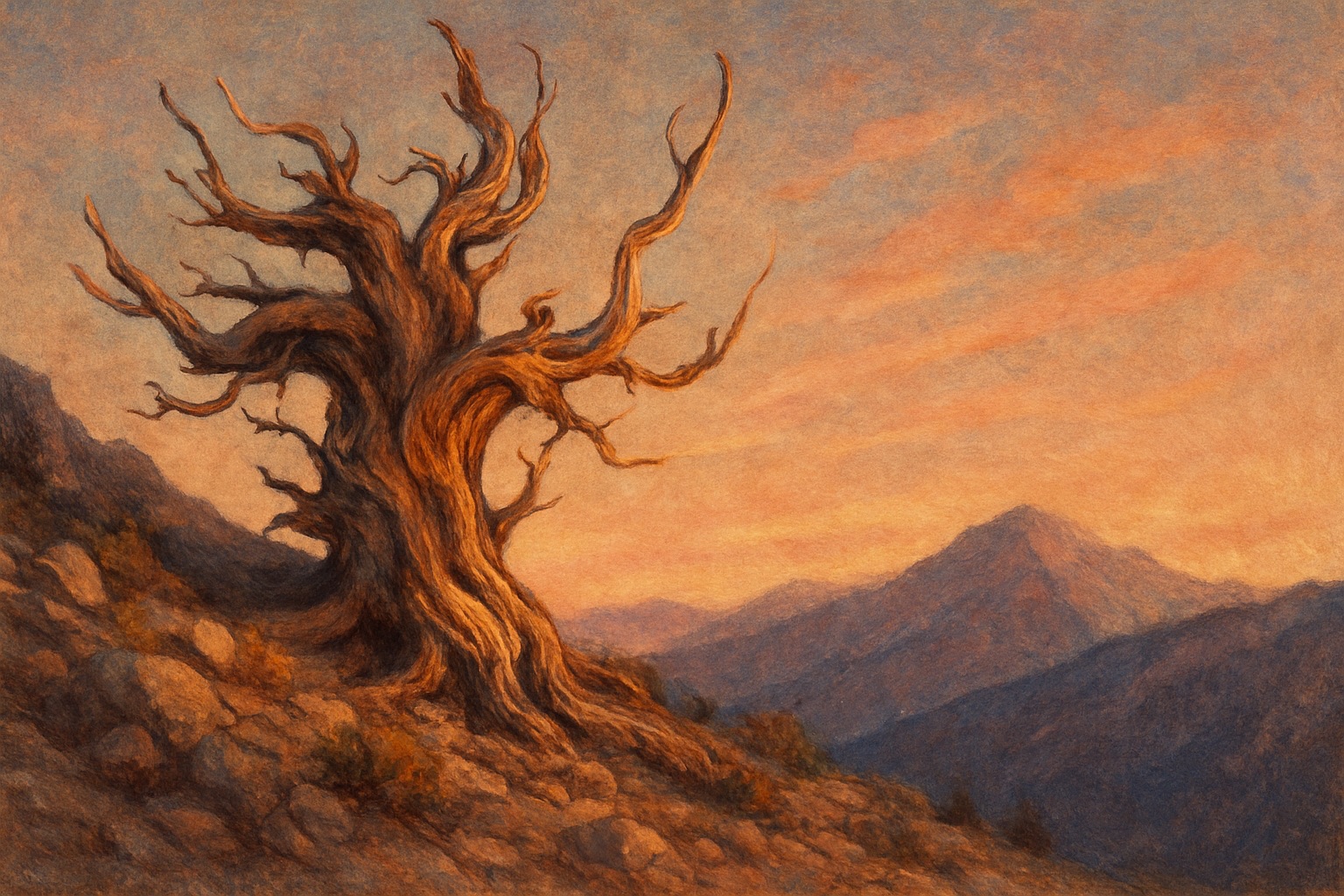
The oldest known living tree sprouted before the Great Pyramid was finished.
Methuselah, a Great Basin bristlecone pine in California's White Mountains, is roughly 4,850 years old — germinating around the time Egypt was still stacking Giza. The U.S. Forest Service keeps its exact location secret to protect it from souvenir hunters.
The world's oldest company built Buddhist temples for over 1,400 years.
Kongo Gumi was founded in Japan in 578 AD to build the Shitenno-ji temple in Osaka and stayed in the founding family for some 40 generations. It finally lost independence in 2006, when it was absorbed as a subsidiary — where it still builds temples today.
The oldest written recipes are 3,700-year-old stews.
A set of Babylonian clay tablets held at Yale, dated to around 1730 BC, records some two dozen recipes — mostly meat and vegetable stews heavy on leeks and garlic. Scholars and chefs cooked them in 2019, and the reviews were respectful but mixed; an even older Sumerian hymn to the goddess Ninkasi doubles as a beer recipe in verse.
The oldest recorded joke is a fart joke.
A 2008 University of Wolverhampton survey crowned a Sumerian proverb from around 1900 BC the world's oldest known joke: 'Something which has never occurred since time immemorial — a young woman did not fart in her husband's lap.' Comedy has been consistent for four thousand years.
The oldest leather shoe is 5,500 years old and about a women's size 7.
Found in Armenia's Areni-1 cave in 2008, the single laced leather shoe was stuffed with grass and preserved under layers of sheep dung in cool, dry conditions. Older footwear does exist — sagebrush-bark sandals from Oregon are closer to 10,000 years old — but this is leather's record-holder.
The oldest written melody is about 3,400 years old — and we're still arguing about how it goes.
The Hurrian Hymn No. 6, on a clay tablet from the ancient city of Ugarit, is the oldest known piece of notated music, though scholars dispute how to read the notation. The oldest complete surviving song, the Greek Seikilos epitaph, comes with words worth keeping: 'While you live, shine.'
A clam named Ming lived 507 years — spanning from the Ming dynasty to smartphones.
The ocean quahog, dredged off Iceland in 2006, was born around 1499, making it the longest-lived non-colonial animal ever verified. Researchers initially undercounted its age by about a century; the corrected figure came in 2013.
The world's oldest hotel has been taking guests since 705 AD.
Nishiyama Onsen Keiunkan, a hot-spring inn in Japan's Yamanashi prefecture, has operated continuously for more than 1,300 years under roughly 52 generations of the same family. Guinness certifies it as the oldest hotel on Earth.
The oldest water on Earth is two billion years old — and someone tasted it.
Pockets of ancient water sealed nearly three kilometers down in Ontario's Kidd Creek mine have been isolated for around two billion years. Geologist Barbara Sherwood Lollar, whose team studies it, has confirmed the flavor profile: intensely salty and thoroughly terrible.
The oldest piece of the planet is a crystal you could balance on a pinhead.
Zircon crystals from the Jack Hills of Western Australia have been dated to about 4.4 billion years — only some 150 million years younger than Earth itself. They're evidence the young planet cooled and had liquid water far earlier than once assumed.
The oldest customer complaint is 3,700 years old — and the reviews are brutal.
Around 1750 BC, a Babylonian customer named Nanni sent merchant Ea-nasir a clay tablet fuming about substandard copper ingots and rude treatment of his messengers. The tablet survives in the British Museum, where Ea-nasir has posthumously become the internet's favorite bad vendor.
The oldest known bread is about 4,000 years older than farming.
In 2018, archaeologists reported charred flatbread crumbs from Shubayqa 1, a hunter-gatherer site in Jordan, dated to around 14,400 years ago — millennia before anyone domesticated wheat. The bakers ground wild grains and tuber roots into flour, which suggests a delicious possibility: bread wasn't a product of agriculture, it may have been the motivation for it.
The oldest chewing gum still has teeth marks in it.
Wads of chewed birch-bark pitch found at Huseby Klev in Sweden are roughly 10,000 years old, tooth impressions included. A 5,700-year-old Danish piece went one better: scientists extracted a complete human genome from it, reconstructing its chewer — a dark-haired, blue-eyed woman they nicknamed Lola.
Empires rose, fell, and were forgotten — but Ea-nasir's one-star copper review is still on file. Choose your legacy carefully.