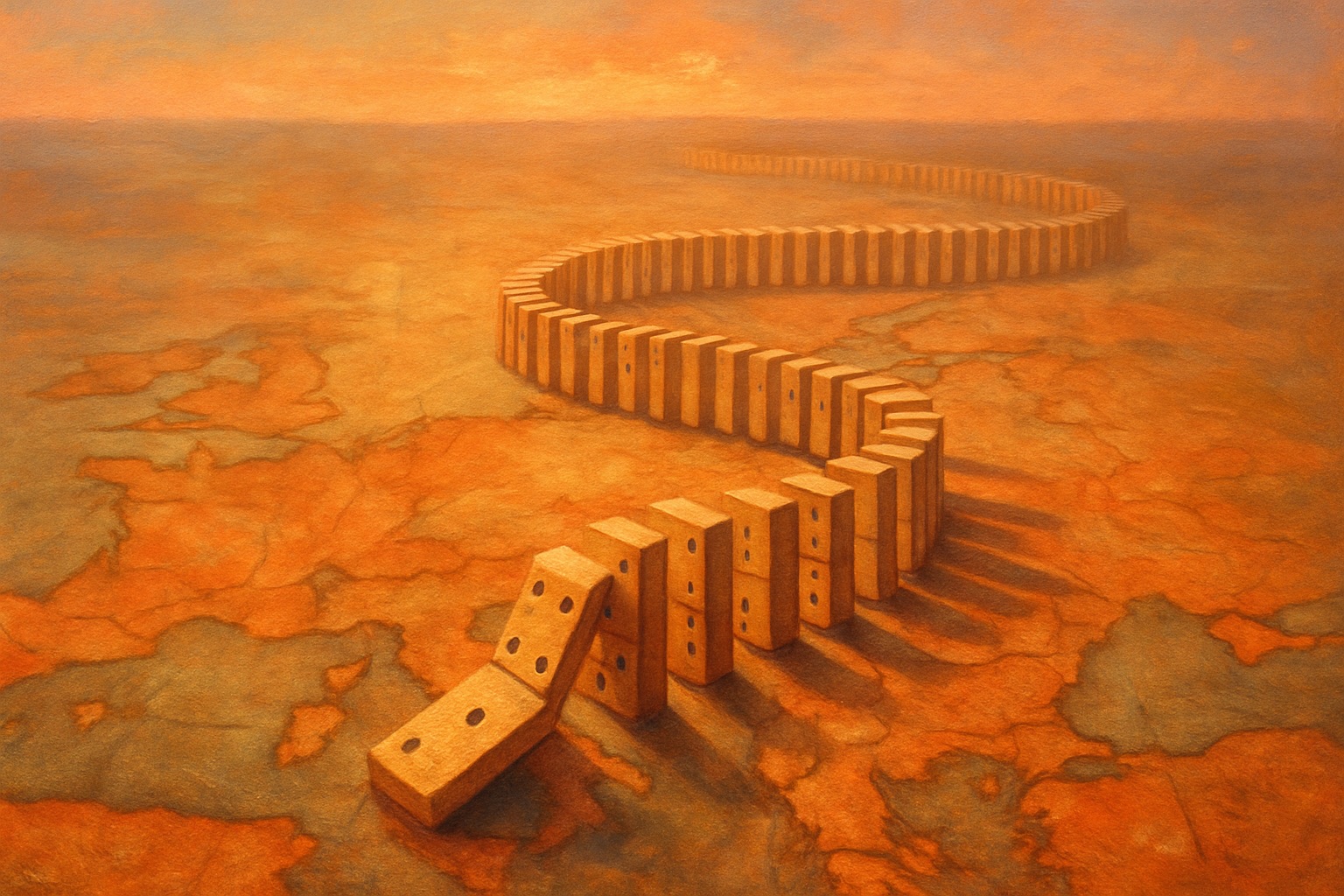
History likes to dress itself up as grand strategy, but an alarming amount of it comes down to someone taking a wrong turn or pocketing the wrong key. Here are the smallest hinges that swung the biggest doors.
A driver's wrong turn started World War I.
On June 28, 1914, Archduke Franz Ferdinand's driver mistakenly turned onto a Sarajevo side street and stopped to reverse — directly in front of Gavrilo Princip, whose conspirators had already botched a bombing that morning. Two shots later, the dominoes toward a war that killed many millions began to fall.
A reassigned officer pocketed one key — and the Titanic's lookouts sailed without binoculars.
David Blair was bumped from the crew at Southampton days before the 1912 maiden voyage and left with the key to the crow's-nest locker that held the lookouts' glasses. Lookout Fred Fleet later testified that with binoculars they might have seen the iceberg 'soon enough to get out of the way' — though whether that's true is still argued. The key sold at auction in 2007 for around £90,000.
Clouds over one city sent the atomic bomb to another.
On August 9, 1945, the second bomb's primary target was Kokura, but haze and smoke obscured the aiming point, and after three passes the crew diverted to the backup target — Nagasaki. Japanese speakers still invoke the luck of Kokura.
One Soviet officer decided the missile alert was a glitch.
In September 1983, Stanislav Petrov's early-warning system reported American missiles inbound; protocol pointed toward reporting an attack, but he judged it a malfunction and waited. It turned out to be sunlight glinting off clouds — and his call may have prevented a nuclear war.
One vote on a submarine kept the Cuban Missile Crisis cold.
In October 1962, a Soviet sub being pounded by American depth charges prepared a nuclear torpedo; launch required three senior officers to agree, and Vasili Arkhipov alone said no. That single refusal is a big part of why the crisis stayed a crisis.
Three cigars changed the American Civil War.
In 1862, Union soldiers resting in a Maryland field found a copy of Robert E. Lee's complete battle plans wrapped around three cigars. The find led to the Battle of Antietam, whose result gave Lincoln the opening he needed to issue the Emancipation Proclamation.
A fumbled press conference opened the Berlin Wall.
On November 9, 1989, East German spokesman Günter Schabowski misread a hastily handed note and announced that new travel rules took effect immediately. Crowds mobbed the checkpoints, an overwhelmed border officer opened his gate, and the Wall was effectively finished by midnight.
A marshal followed orders instead of the sound of cannons.
At Waterloo in 1815, Marshal Grouchy — commanding a third of Napoleon's army — heard the battle's guns in the distance and, over his subordinates' pleas to march toward them, stuck to his orders to chase the Prussians. The Prussians reached Waterloo anyway; Grouchy never did.
A folded speech stopped a bullet.
In 1912, a would-be assassin shot Theodore Roosevelt in the chest, but the 50-page speech and steel eyeglass case in his breast pocket slowed the round. Roosevelt, being Roosevelt, delivered the speech anyway — for the better part of an hour and a half, bleeding.
A failed meeting handed Microsoft the world.
In 1980, IBM needed an operating system for its new PC and could not close a deal with the leading vendor, Digital Research — exactly why remains a legend-encrusted argument. It turned instead to Bill Gates, who bought a cheap operating system from a small Seattle firm, licensed it to IBM, and built an empire on the fallout.
Sleep well knowing the fate of the 20th century once came down to one Soviet officer's gut feeling about a blinking screen.